In software engineering, we often “Move Fast and Break Things.” The problem is, eventually, you have to fix the things you broke.
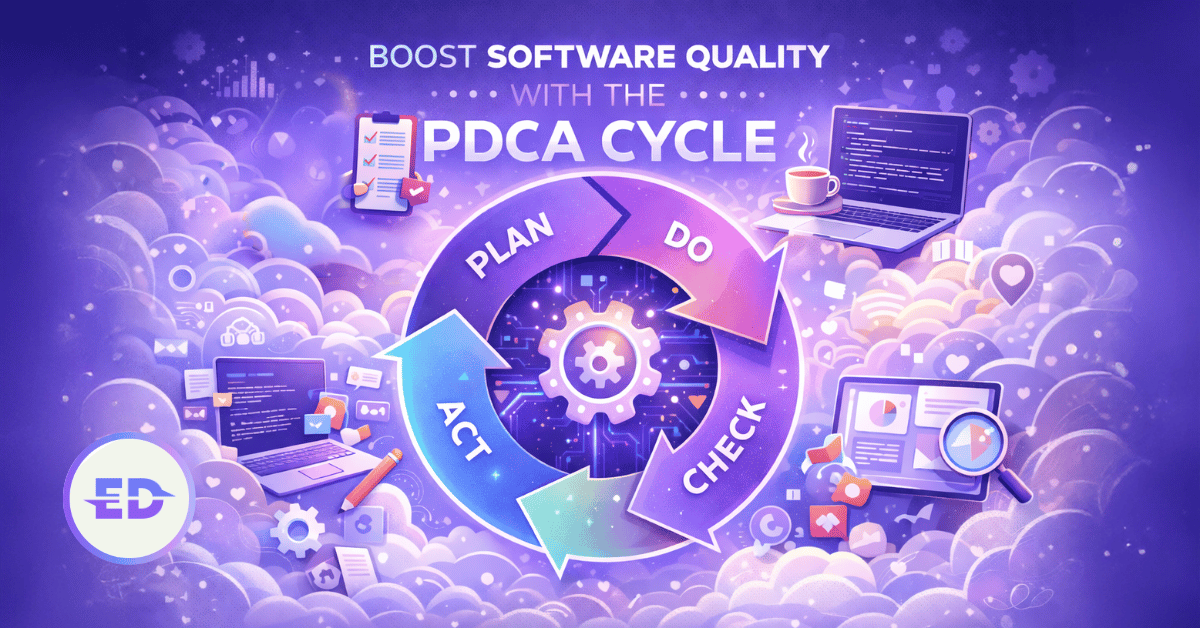
The PDCA Cycle (Plan-Do-Check-Act) is the antidote to technical debt. It’s not just a manufacturing concept from the 1950s; it is the hidden engine behind high-performing engineering teams at Google, Netflix, and Amazon.
In 2026, PDCA isn’t a management buzzword. It’s the difference between a team that ships buggy code every Friday and a team that ships flawless updates daily.
PDCA: The Engineering Translation
Here is how the 4 stages map to modern DevOps and Agile workflows.
1. Plan (The RFC)
Before you write a single line of code, you must minimize ambiguity.
- Old Way: “Let’s build a chat feature.” (Vague)
- PDCA Way: Write a Request for Comments (RFC) document.
- Architecture: SQL or NoSQL?
- Trade-offs: Real-time vs. consistency?
- Estimates: T-shirt sizing. Goal: Identifying the “unknown unknowns” before they become “bugs.”
2. Do (The Build)
This is where the code gets written. In 2026, “Do” involves AI-augmented coding.
- Best Practice: Use AI (GitHub Copilot/Cursor) to write boilerplate, but humans must write the logic.
- The Golden Rule: Keep pull requests (PRs) small. A 200-line PR gets reviewed; a 2,000-line PR gets “Looks Good To Me” (LGTM) and ships with bugs.
3. Check (The CI/CD Pipeline)
This is the most critical step. “Checking” shouldn’t happen in production.
- Automated Testing: Unit tests (Jest), Integration tests (Cypress).
- Static Analysis: Linters and Security scanners.
- Code Review: The final human gate. Focus: If the build fails, the line stops. No exceptions.
4. Act (The Retrospective)
This is where continuous improvement happens. If a bug leaks to production, you don’t just fix it; you fix the process that allowed it to happen.
- The Blameless Postmortem:
- What happened? “Database CPU spiked to 100%.”
- Why? “We merged a query without an index.”
- The Action: “Add a CI check that blocks PRs with missing indexes.”
Case Study: The “Hotfix” Loop
Bad teams stay in the Do-Check loop (Coding -> Testing -> Bug -> Coding). Great teams live in the Act-Plan loop.
A team that uses PDCA correctly will say: “We spent 3 days planning this migration, so we executed it in 30 minutes with zero downtime.”
Tools for PDCA in 2026
| Phase | Tool of Choice | Usage |
|---|---|---|
| Plan | Notion / Google Docs | Writing RFCs and Tech Specs. |
| Do | VS Code + Copilot | Writing code and documentation. |
| Check | GitHub Actions / Datadog | Automated testing and observability. |
| Act | Linear | Creating “Prevention Tasks” from retrospectives. |
Conclusion
PDCA is technically simple but culturally hard. It requires the discipline to stop, analyze, and improve, rather than just rushing to the next feature.
If you want to be a Senior Engineer, stop focusing only on the “Do” (coding). Start mastering the “Plan” (architecture) and the “Act” (process improvement). That is how you scale yourself and your team.
FAQ
Is PDCA the same as Agile? They are cousins. Agile is the structure (Sprints, Standups). PDCA is the mechanism inside Agile that drives improvement. A Sprint is essentially a 2-week PDCA cycle.
How do I use PDCA for a hotfix? Even in an emergency, use a micro-PDCA.
- Plan: “Is this the right fix? Will it break anything else?”
- Do: Apply the patch.
- Check: Verify on staging.
- Act: Deploy and then schedule a root cause analysis.
Does this slow down development? In the short term, yes. Planning takes time. But in the long term, it is significantly faster because you avoid rollbacks, hotfixes, and debugging sessions at 3 AM.
What is the “Check” phase in DevOps? It’s Observability. Tools like Datadog or honeycomb.io let you “Check” the health of your system in real-time. You aren’t just checking code; you’re checking user experience.
Can I use PDCA as a solo developer? Yes.
- Plan: Write a to-do list for the day.
- Do: Code.
- Check: Review your work at 5 PM. “Did I finish? If not, why?”
- Act: Adjust your schedule for tomorrow.
What is the biggest mistake with PDCA? Skipping the “Act” phase. Teams identify problems in the retrospective (“We need better tests”) but never actually schedule the work to fix it. The loop breaks, and the problem repeats.