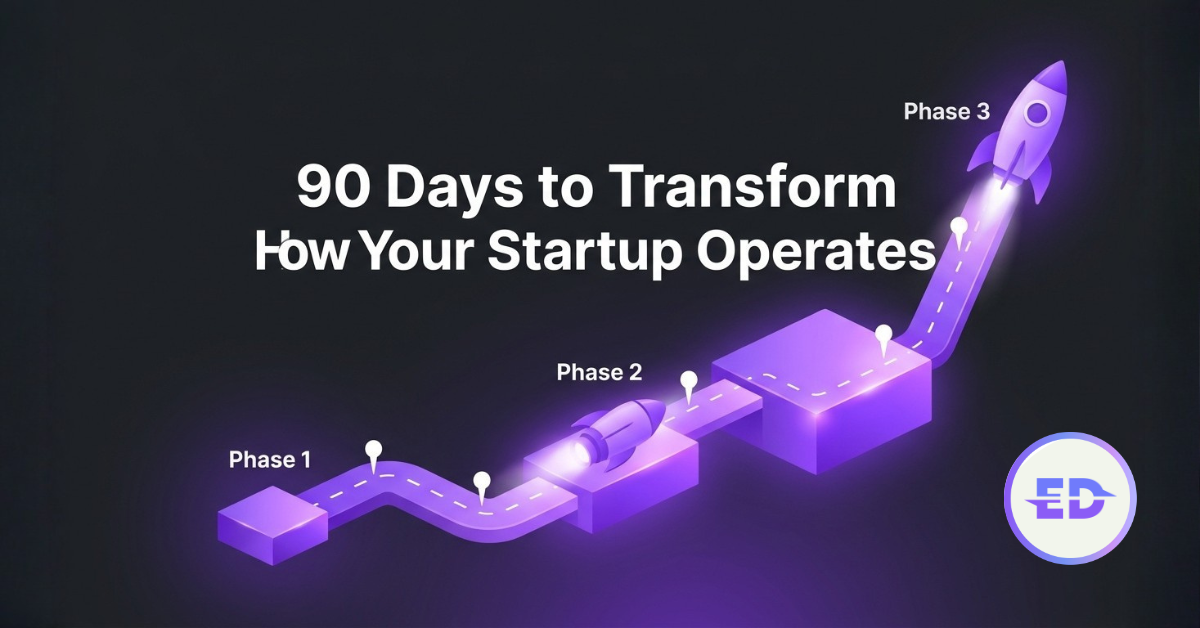
Introduction: From AI Curiosity to AI Competence in 90 Days
Most startups approach AI adoption in one of two dysfunctional ways. Some treat it as a future initiative - something they will get to once the product is stable and the team is larger. Others adopt AI tools haphazardly - a chatbot here, an automation there - without a coherent strategy connecting these tools to business outcomes.
The 90-Day AI Growth Plan is a structured framework that takes a startup from AI-curious to AI-competent in one quarter. By the end of 90 days, every major business function will have at least one AI-powered workflow, the team will have developed practical AI fluency, and the operational efficiency gains will be measurable and significant.
This is not a theoretical framework. It is an execution plan with specific weekly milestones, tool recommendations, and success metrics.
Pre-Work: The AI Audit (Week 0)
Before the 90-day plan begins, conduct a one-day audit of your current operations.
Map Every Repetitive Task
Walk through each team member’s weekly routine and identify tasks that are repetitive, rule-based, or data-processing-heavy. Common examples: formatting and sending reports, scheduling meetings and follow-ups, categorising support tickets, writing first drafts of emails and content, manual data entry between systems, creating meeting summaries, and researching prospects before outreach.
Quantify the Time Cost
For each repetitive task, estimate hours per week. Most startups find 30-50 hours per week of total team time spent on tasks that AI can partially or fully automate.
Prioritise by Impact
Rank tasks by two criteria: time consumed and value if automated. The tasks that consume the most time AND create the most value when automated are your Phase 1 targets.
Phase 1: Foundation (Days 1-30)
The goal of Phase 1 is to implement AI tools that deliver immediate, tangible time savings across the team.
Week 1: AI Writing and Communication
Deploy an AI writing assistant (Claude or ChatGPT) for the entire team. Train the team on effective prompting - providing context, specifying tone and format, and iterating on outputs. Set up AI-assisted email drafting for customer communication.
Milestone: Every team member uses AI for at least 3 writing tasks per day. Expected impact: 5-8 hours per week recovered across the team.
Week 2: Meeting Intelligence
Deploy a meeting transcription and summary tool (Fireflies.ai or Otter.ai). Configure automatic recording for all internal and external meetings. Set up automated distribution of meeting summaries and action items to relevant channels.
Milestone: 100% of meetings are recorded and summarised automatically. Expected impact: 3-5 hours per week recovered (note-taking, summary writing, follow-up clarification).
Week 3: Workflow Automation with AI
Set up Zapier or Make with AI-powered steps. Build 5 automations targeting your highest-priority repetitive tasks: new lead notification and enrichment, customer onboarding email sequences, support ticket classification and routing, weekly metrics compilation and distribution, and social media mention alerting.
Milestone: 5 active automations running without manual intervention. Expected impact: 5-10 hours per week recovered.
Week 4: Consolidation and Measurement
Review the first month’s impact. Calculate actual hours saved versus projection. Identify which tools are being used consistently and which are being ignored (address adoption barriers). Document the workflows and create SOPs for AI-assisted processes. Survey the team on what is working and what needs adjustment.
Phase 1 Target: 15-25 hours per week of team time recovered. Equivalent value: Rs 1.5-4 lakh per month.
Phase 2: Growth Engine (Days 31-60)
Phase 2 focuses on using AI to improve revenue-generating activities - marketing, sales, and customer success.
Week 5: AI-Powered Content Engine
Set up an AI-assisted content production workflow: keyword research using AI-enhanced SEO tools (Surfer, Clearscope), content briefs generated by AI based on competitive analysis, first drafts generated by AI following brand guidelines and content briefs, and human editing and refinement before publication.
Milestone: Content production rate doubles (e.g., from 4 to 8 articles per month). Expected impact: 2x content output with the same team.
Week 6: AI-Enhanced Sales Process
Implement AI-powered lead scoring in your CRM (HubSpot AI, Freshsales Freddy). Set up Clay or Apollo for automated prospect enrichment and personalised outreach generation. Deploy conversation intelligence for sales call analysis (Gong or a lighter tool like Fireflies’ conversation insights).
Milestone: Sales team spends 30% less time on research and admin, 30% more time on qualified conversations. Expected impact: 20-40% improvement in sales efficiency.
Week 7: Customer Success Automation
Build AI-powered churn risk detection using product usage data and CRM signals. Create automated check-in sequences triggered by usage patterns (declining usage triggers proactive outreach). Set up AI-assisted response suggestions for customer success managers.
Milestone: Churn risk identification moves from reactive to proactive. Expected impact: 10-20% reduction in churn rate over the following quarter.
Week 8: Analytics and Intelligence
Connect all data sources to a centralised dashboard (Metabase, Looker Studio). Set up AI-powered anomaly detection that alerts the team when key metrics deviate from expected ranges. Build a weekly AI-generated business intelligence summary that synthesises data from all sources into narrative insights.
Milestone: Weekly business review is informed by AI-generated insights, not just raw data. Expected impact: Faster and better-informed decision-making.
Phase 2 Target: Measurable improvements in content output (2x), sales efficiency (20-40%), and churn reduction (10-20%). Revenue impact: difficult to quantify precisely but typically Rs 5-15 lakh in annual revenue improvement for a Rs 50 lakh-1 crore ARR company.
Phase 3: Competitive Advantage (Days 61-90)
Phase 3 focuses on embedding AI into your product and building capabilities that competitors cannot easily replicate.
Week 9: Product AI Features
Identify 2-3 product features that can be enhanced with AI. These might be personalised recommendations, intelligent search, automated data analysis for users, or AI-generated insights from user data. Implement the highest-impact feature using foundation model APIs.
Milestone: One AI-powered product feature live in production. Expected impact: Measurable improvement in the product metric the feature targets (engagement, retention, or revenue).
Week 10: Proprietary Data Advantage
Begin building the data infrastructure that makes your AI capabilities improve over time. This means logging user interactions with AI features, collecting feedback on AI output quality, and building training datasets from your proprietary data.
Milestone: Data collection pipeline live for at least one AI feature. Expected impact: Foundation for continuous AI improvement.
Week 11: AI Playbook Documentation
Document every AI workflow, tool, and process implemented over the past 10 weeks. Create an internal AI playbook that covers tool access and credentials, workflow documentation with SOPs, prompt libraries for common tasks, and training materials for new team members.
Milestone: Complete AI playbook accessible to the entire team. Expected impact: AI capabilities survive team turnover and scale with new hires.
Week 12: Review, Optimise, Plan
Conduct a comprehensive 90-day review. Measure total hours saved per week. Calculate revenue impact from improved sales, marketing, and customer success metrics. Identify the highest-ROI AI implementations and double down. Plan the next 90-day AI roadmap based on learnings.
Phase 3 Target: At least one AI-powered product feature live. Complete internal AI playbook. Clear roadmap for the next quarter of AI development.
The 90-Day Scorecard
Efficiency Metrics
Hours recovered per week: Target 25-40 across the team. Cost of AI tools: Rs 20,000-60,000/month. Net value created: Rs 2-5 lakh/month (hours recovered minus tool costs).
Growth Metrics
Content output increase: Target 2-3x. Sales efficiency improvement: Target 20-40%. Churn rate reduction: Target 10-20%. Lead-to-customer conversion improvement: Target 10-25%.
Capability Metrics
AI workflows implemented: Target 15-20. Team AI fluency (percentage using AI daily): Target 90%+. AI-powered product features: Target 1-2. Internal AI playbook: Complete.
Common Pitfalls and How to Avoid Them
Pitfall 1: Tool overload. Starting with too many tools simultaneously leads to adoption fatigue. Introduce 1-2 tools per week maximum.
Pitfall 2: Skipping the human review. AI output requires human oversight, especially in customer-facing applications. Never automate without a review step until the AI has proven its reliability over 100+ instances.
Pitfall 3: Ignoring adoption. The best AI tool is worthless if the team does not use it. Track adoption metrics weekly and address resistance through training and demonstrated value, not mandates.
Pitfall 4: Measuring inputs, not outcomes. “We implemented 20 AI workflows” is an input metric. “We recovered 35 hours per week and improved sales conversion by 25%” is an outcome metric. Focus on outcomes.
Pitfall 5: Treating the 90-day plan as a one-time project. AI adoption is continuous. The 90-day plan establishes the foundation; subsequent quarters build on it. Plan the next 90 days before the current plan ends.
FAQ
What does the 90-Day AI Growth Plan actually achieve? By the end of 90 days, every major business function has at least one AI-powered workflow, the team has developed practical AI fluency with 90%+ daily usage, and operational efficiency gains are measurable - typically 25-40 hours per week recovered, content output doubled, sales efficiency improved by 20-40%, and churn reduced by 10-20%. The total cost is Rs 20,000-60,000/month in tools.
How much time should I expect AI tools to save my team in the first month? Phase 1 (Days 1-30) targets 15-25 hours per week across the team. This comes from AI writing assistants (5-8 hours), meeting transcription (3-5 hours), and workflow automation (5-10 hours). At Rs 500-800 per hour of professional time, this translates to Rs 1.5-4 lakh per month in recovered value - often exceeding the cost of all AI tools combined.
What if my team resists using AI tools? Resistance is the most common pitfall. Address it through demonstrated value (show time savings with specific examples), leading by example (the founder uses AI daily and references it in decisions), and training over mandates (help people see AI as a capability multiplier, not a threat). Track adoption metrics weekly and introduce only 1-2 new tools per week to avoid tool fatigue.
Should I use the 90-Day Plan if my startup has only 2-3 people? Yes, but scale it down. With 2-3 people, focus on Phase 1 (writing + transcription + 3 automations) and the content engine from Phase 2. Skip team-level tools like conversation intelligence until you have 3+ salespeople. Even for a solo founder, AI writing assistants and automation save 10-15 hours per week - enough to justify the investment.
What happens after the 90 days are complete? The 90-day plan establishes the foundation, not the ceiling. Plan your next 90-day AI roadmap before the current plan ends. Subsequent quarters should deepen existing capabilities, expand to remaining business functions, build proprietary data advantages, and explore AI features in your core product. AI adoption is continuous - each quarter compounds the advantages.
Key Takeaway
“The 90-Day AI Growth Plan is not about becoming an AI company. It is about becoming a company that uses AI as naturally as it uses email. By the end of 90 days, AI is not a special initiative - it is how your team works. That transformation, more than any single tool or workflow, is the lasting competitive advantage.” - Evan D’Souza, Growth Architect
Part of the AI-Powered Business Strategy series on evandsouza.com.