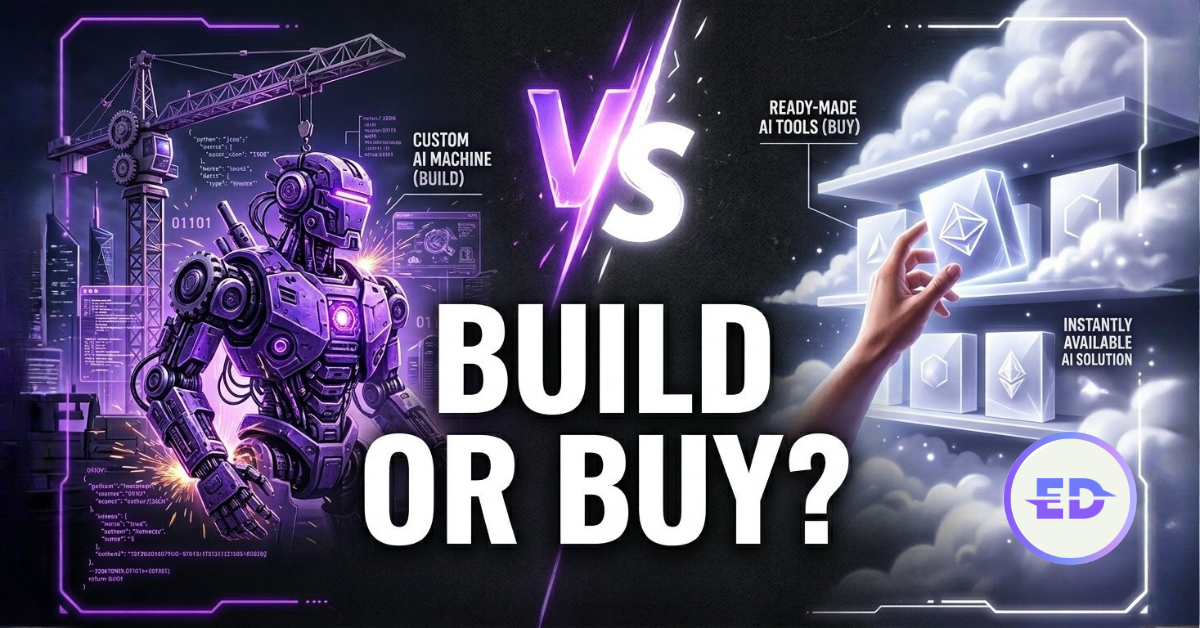
Introduction: The Most Expensive Decision You Will Make About AI
Every startup integrating AI faces a recurring decision: should we build custom AI capabilities in-house, or should we buy (subscribe to) existing AI-powered tools?
The stakes are high in both directions. Building custom AI when a reliable tool exists wastes engineering resources and delays time to value. Buying generic tools when your use case requires custom AI creates dependency on solutions that do not fit and limits your competitive differentiation.
This guide provides a decision framework for the build-vs-buy choice at each stage of startup growth, covering cost analysis, capability requirements, and the strategic implications of each path.
The Decision Framework: Five Factors
Factor 1: Core vs. Context
The most important distinction is whether the AI capability is core to your product and competitive advantage, or contextual (supporting operations but not differentiating your product).
Core AI (Build): AI capabilities that are directly experienced by your customers and differentiate your product. A recommendation engine for a content platform, a risk scoring model for a fintech product, or a diagnostic algorithm for a healthtech application. These should be built in-house because they are the source of competitive advantage and require deep integration with your proprietary data.
Context AI (Buy): AI capabilities that improve internal operations but are not visible to customers or differentiating. Customer support automation, content generation, lead scoring, expense categorisation. These should be purchased because they are solved problems - building them from scratch reinvents the wheel.
Factor 2: Data Advantage
AI systems improve with data. If your startup has proprietary data that would make a custom AI system significantly better than generic alternatives, building makes sense. If you are working with the same data available to everyone, buying a tool that has already been trained on broad datasets is more efficient.
Questions to ask: Do we have proprietary data that generic AI tools cannot access? Would a custom model trained on our data meaningfully outperform a general-purpose tool? Is our data volume sufficient to train a useful model (typically thousands of examples minimum)?
Factor 3: Cost Comparison (Total Cost of Ownership)
Buy costs: Monthly subscription fees (Rs 2,000-50,000/month for most startup tools), integration and setup time (typically 1-4 weeks), ongoing customisation and maintenance, and the risk of vendor lock-in and price increases.
Build costs: Engineering time for development (4-16 weeks for most AI features), infrastructure costs for model training and hosting (Rs 10,000-1,00,000/month for cloud GPU resources), ongoing maintenance, monitoring, and improvement (20-30% of initial development cost per year), and the opportunity cost of engineering time not spent on other priorities.
For most startups before Rs 5 crore ARR, the buy option is 3-5x more cost-effective for contextual AI needs. The math shifts toward building only when the AI capability is core to the product or when subscription costs exceed Rs 50,000/month for a single tool.
Factor 4: Speed to Value
Buying delivers value in days to weeks. Building delivers value in weeks to months. For startups in competitive markets, the speed advantage of buying is often decisive.
The exception: if no existing tool serves your specific use case well, building is the only option. But verify this thoroughly before committing - the AI tool landscape in 2026 is remarkably comprehensive, and many founders underestimate how well existing tools can be configured for their needs.
Factor 5: Team Capability
Building AI requires specific skills: ML engineering, data engineering, and MLOps. If your team has these skills and they are not fully utilised on core product development, building is viable. If hiring or diverting these skills is required, the hidden cost is substantial.
For teams without ML expertise, the “build with APIs” middle ground is often optimal - using foundation models (GPT-4, Claude, Gemini) via API with custom prompts and fine-tuning rather than training models from scratch.
The Decision Matrix by Use Case
Customer Support - Buy
Mature solutions exist (Intercom, Freshdesk, Zendesk) with AI that handles 40-60% of queries. Building custom support AI makes sense only if your product domain is highly specialised and existing tools’ knowledge bases are insufficient.
Content Generation - Buy (with customisation)
Use API access to foundation models with custom prompts and brand guidelines. Building a custom content model is unjustified for virtually all startups - the foundation models are extraordinarily capable with the right prompting.
Lead Scoring - Buy, then Build
Start with CRM-native AI scoring (HubSpot, Freshsales). As your data grows and generic scoring proves insufficient, build custom scoring models trained on your conversion data. The transition typically happens around Rs 1 crore ARR when you have enough data to train meaningful models.
Recommendation Engine - Build
If recommendations are core to your product experience, build in-house using foundation model APIs with your proprietary product and user data. The personalisation advantage of custom recommendations trained on your data significantly outperforms generic solutions.
Financial Operations - Buy
Accounting, invoicing, and expense management AI is thoroughly commoditised. Building custom financial AI is almost never justified for non-fintech startups.
Pricing Optimisation - Build with APIs
Dynamic pricing is strategic enough to warrant custom development, but the AI component can leverage foundation model APIs rather than custom ML. Feed your pricing data, competitor data, and demand signals to a well-prompted AI model for pricing recommendations.
The Hybrid Approach: Buy the Foundation, Build the Differentiation
For most startups, the optimal strategy is hybrid: buy existing AI tools for operational needs and build custom AI capabilities for core product features.
Implementation: use off-the-shelf tools (Zapier AI, CRM AI, support AI) for all contextual operations. Use foundation model APIs (OpenAI, Anthropic, Google) with custom prompts and fine-tuning for semi-custom needs. Build fully custom models only for core product AI where proprietary data creates a meaningful advantage.
This approach minimises cost, maximises speed to value, and reserves engineering resources for the AI capabilities that actually differentiate your product.
The Build Readiness Checklist
Before committing to build any AI capability, confirm: you have identified a specific problem that no existing tool solves adequately, you have or can acquire sufficient data to train a useful model, you have the engineering capability on team (or can hire it without derailing other priorities), the expected ROI justifies the development and maintenance cost, and the capability is core to your product differentiation.
If any of these conditions is not met, buy first and re-evaluate in 6 months.
FAQ
When should a startup build custom AI vs buying existing tools? Build when the AI capability is core to your product and differentiates you from competitors - like a recommendation engine or proprietary analytics. Buy when the AI is contextual (supporting operations but not differentiating) - like customer support automation, content generation, or expense categorisation. Most startups before Rs 5 crore ARR should buy 80-90% of their AI needs and only build for core product features.
How much does it cost to build custom AI features for a startup? Building custom AI requires 4-16 weeks of engineering time (at Rs 1-3 lakh per engineer per month), infrastructure costs of Rs 10,000-1,00,000/month for cloud GPU resources, and ongoing maintenance at 20-30% of initial development cost per year. For most use cases, buying an existing solution at Rs 2,000-50,000/month is 3-5x more cost-effective. Building custom AI is only justified when proprietary data creates a meaningful advantage.
What is the “build with APIs” middle ground? Instead of training models from scratch (expensive and slow) or buying packaged tools (limited customisation), you can use foundation models (GPT-4, Claude, Gemini) via API with custom prompts and fine-tuning. This gives you the customisation of building without the cost of training. It is ideal for teams without ML expertise who need semi-custom AI capabilities like pricing optimisation or personalised recommendations.
How do I avoid vendor lock-in with AI tools? Document all workflows and their logic independently of any specific tool. Use open-source alternatives where possible (n8n for automation, Appsmith for internal tools). Avoid building your core product on no-code platforms. For non-critical operational tools, accept some lock-in as a trade-off for speed - these are replaceable. Reserve concern for core product dependencies.
At what stage should a startup transition from buying to building AI? Consider building when your data volume is sufficient (thousands of examples), a custom model would meaningfully outperform generic alternatives, you have ML engineering capability on team, and the expected ROI justifies development costs. This transition typically happens around Rs 1 crore ARR for AI capabilities like lead scoring, and earlier for core product AI features that define your competitive positioning.
Key Takeaway
“The best AI strategy for startups is not ‘build everything’ or ‘buy everything’ - it is ruthless clarity about what is core and what is context. Buy context AI tools to operate efficiently. Build core AI capabilities to compete effectively. The discipline to distinguish between the two is what separates capital-efficient startups from those that burn resources on undifferentiated engineering.” - Evan D’Souza, Growth Architect
Part of the AI-Powered Business Strategy series on evandsouza.com.