Introduction
Pricing is the most under-optimised lever in Indian SaaS. Most founders spend months on product development and marketing strategy but set their pricing in a single afternoon, often by looking at competitors and choosing a number that “feels right.”
The impact of this neglect is significant. A 10% improvement in pricing has a larger impact on profitability than a 10% improvement in customer acquisition or a 10% reduction in costs. For an Indian SaaS company at Rs 50 lakh ARR, optimising pricing can add Rs 5-10 lakh to the bottom line without acquiring a single new customer.
This guide covers the major pricing frameworks, Indian-market-specific considerations, and a practical process for setting and iterating on your SaaS pricing in 2026.
The Three Pricing Frameworks
Cost-Plus Pricing
Calculate your cost to serve each customer (infrastructure, support, development allocation) and add a margin. This is the simplest approach but also the least effective. It ignores the value you deliver and often leads to significant underpricing for products that provide high ROI to customers.
Competitor-Based Pricing
Price relative to alternatives in the market. This approach is useful as a reference point but dangerous as a primary strategy. If your product delivers more value than competitors, pricing at parity leaves money on the table. If you price below competitors, you signal lower quality.
Value-Based Pricing
Price based on the economic value your product delivers to customers. This is the gold standard for SaaS pricing and the approach recommended for Indian SaaS companies in 2026.
The process involves:
- Quantifying the business impact of your product for a typical customer
- Identifying what percentage of that value the customer would be willing to share with you (typically 10-20%)
- Structuring pricing to capture that value
For example, if your product saves a customer Rs 10 lakh per year through automation, pricing at Rs 1-2 lakh per year captures 10-20% of the value created. The customer sees a clear 5-10x ROI, making the purchase decision straightforward.
Indian Market Pricing Considerations
Several India-specific factors affect SaaS pricing strategy:
Price Sensitivity by Segment: Indian SMBs (companies with under 50 employees) are extremely price-sensitive and compare SaaS costs against the fully loaded cost of an employee doing the same work manually. If your product costs more than one junior employee’s monthly salary (Rs 15,000-25,000/month), the value proposition must be overwhelmingly clear.
Annual vs. Monthly Billing: Indian buyers strongly prefer annual contracts with upfront payment, particularly when offered a 15-25% discount over monthly rates. This preference is driven by budget allocation cycles (annual budgets are easier to defend than monthly expenses) and the perception of commitment.
Rupee Pricing vs. Dollar Pricing: If you sell to both Indian and international customers, maintain separate pricing pages. Indian buyers react negatively to dollar pricing — even at equivalent rupee amounts, dollar denomination creates psychological resistance. Price in INR for the Indian market and in USD for international markets.
GST Implications: In India, SaaS products attract 18% GST. For B2B customers, this is reclaimable as input tax credit and has minimal impact on purchasing decisions. For small businesses and individual users not registered for GST, the 18% adds materially to the cost. Factor this into your pricing for SMB segments.
Free Tier vs. Free Trial: Indian users have a strong preference for free tiers over time-limited trials. A generous free tier (with meaningful limitations that create upgrade motivation) performs better in the Indian market than a 14-day free trial. The free tier serves as an extended evaluation period that aligns with the longer decision-making timelines common in Indian B2B purchasing.
Pricing Structure and Packaging
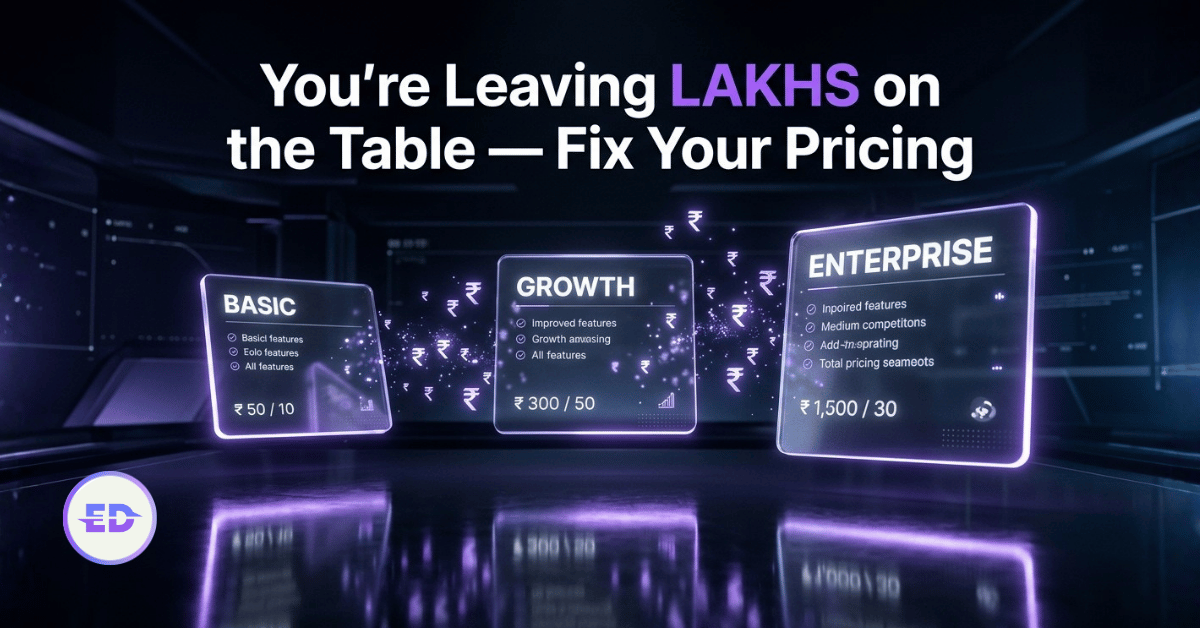
The most effective SaaS pricing structure for the Indian market in 2026 follows a three-tier model:
Starter (Rs 999-4,999/month)
Designed for small teams (1-5 users). Includes core functionality with limitations on volume, integrations, or advanced features. This tier serves as the entry point and the primary conversion target from free users.
Growth (Rs 5,000-19,999/month)
The flagship tier for most Indian SaaS companies. Designed for growing teams (5-25 users). Includes all core features plus advanced analytics, integrations, and priority support. This tier should generate 60-70% of revenue.
Enterprise (Custom pricing, typically Rs 50,000+/month)
For large organisations with complex requirements. Includes everything in Growth plus custom integrations, dedicated account management, SLA guarantees, and security compliance features. This tier generates the highest revenue per customer and often requires a sales-led process.
Pro tip: The packaging decisions within each tier — what to include and what to withhold — are as important as the price itself. Features that affect workflow (integrations, collaboration), scale (user limits, storage), and compliance (audit logs, SSO) are the most effective upgrade drivers.
Iterating on Pricing: A Quarterly Review Process
Pricing is not a one-time decision. The most successful Indian SaaS companies review and adjust pricing quarterly using the following process:
-
Analyse conversion data — What percentage of free users convert to paid? At which tier? What features do they use most before converting? What is the average time from sign-up to first payment?
-
Interview recent customers — Ask five recently converted customers why they upgraded, what their alternatives were, and whether the price felt fair. Ask five customers who churned or downgraded what price would have retained them.
-
Review competitive positioning — Has a new competitor entered at a lower price point? Have existing competitors added features that change the value comparison?
-
Test and implement changes — Run pricing experiments on a small segment (10-20% of new sign-ups) before rolling out changes broadly. Grandfather existing customers at their current pricing for 6-12 months when making increases.
The pricing journey for Indian SaaS follows a predictable pattern: founders start too low, gradually increase as they gain confidence and data, and eventually settle at a price that captures 10-15% of the value they deliver. Accelerating this journey through systematic pricing analysis can add years of compounding revenue growth.
FAQ
How often should a SaaS startup change its pricing? Review pricing quarterly, but only make changes when data supports a clear improvement. Most SaaS companies adjust pricing 2-3 times per year in their first two years and annually after that. Always grandfather existing customers at their current rates for 6-12 months when increasing prices.
Should Indian SaaS startups price in rupees or dollars? Price in INR for the Indian market and USD for international markets. Maintain separate pricing pages. Indian buyers react negatively to dollar pricing even at equivalent amounts — the psychological resistance to foreign currency pricing reduces conversion rates significantly.
Is a free tier better than a free trial for Indian SaaS? For the Indian market, a free tier generally outperforms time-limited free trials. Indian B2B purchasing decisions take longer due to hierarchical approval processes, and a 14-day trial often expires before the evaluation is complete. A free tier with meaningful usage limitations creates a natural upgrade path without time pressure.
What is the most common pricing mistake Indian SaaS founders make? The most common mistake is underpricing — setting prices based on cost-plus or competitive parity rather than the value delivered. Founders fear that higher prices will reduce conversions, but in practice, SaaS products that clearly articulate their ROI can command premium pricing. A 10% price increase typically has less impact on conversion than founders expect.
How should GST affect my SaaS pricing strategy? For B2B customers registered for GST, the 18% GST is reclaimable as input tax credit and rarely affects purchasing decisions. However, for SMBs and individual users not GST-registered, the 18% adds meaningfully to the cost. Consider absorbing GST in your displayed price for SMB tiers to reduce sticker shock, while showing GST-exclusive pricing for enterprise tiers.