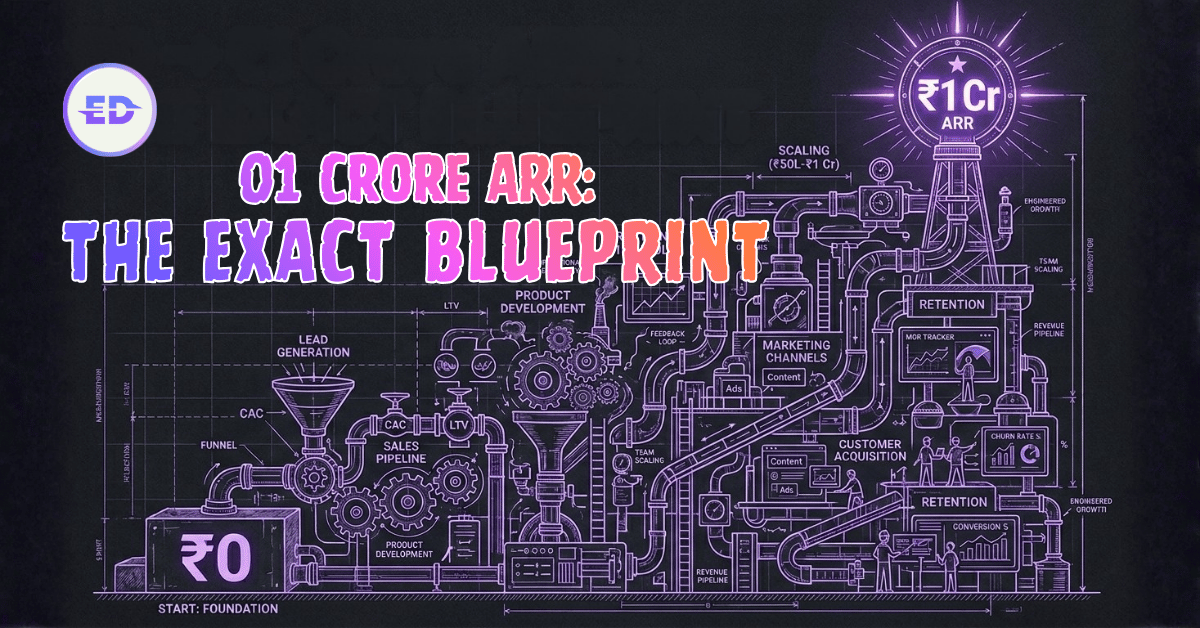
Introduction: The Indian SaaS Landscape in 2026
India has emerged as the world’s second-largest SaaS ecosystem, behind only the United States. By early 2026, Indian SaaS companies collectively generate over $18 billion in annual recurring revenue, with more than 30 companies crossing the $100 million ARR threshold. The ecosystem is no longer defined by a few outliers — Freshworks, Zoho, Chargebee — but by a broad base of companies building specialised, high-value software for both Indian and global markets.
Yet for every success story, there are hundreds of SaaS startups that stall between Rs 10 lakh and Rs 1 crore ARR — the valley of death where initial enthusiasm meets the reality of consistent revenue generation. This guide is designed for founders navigating that specific passage, providing a systematic framework for building predictable, scalable revenue from zero to Rs 1 crore ARR.
The frameworks here are drawn from operational experience across multiple B2B SaaS implementations in India, including product-led growth, sales-assisted growth, and hybrid models.
Chapter 1: Defining Your Growth Model
Before spending a single rupee on growth, you must determine which growth model fits your product, market, and price point. The three primary models are:
Product-Led Growth (PLG)
The product itself drives acquisition, conversion, and expansion. Users sign up, experience value, and convert to paying customers with minimal human intervention. This model works when:
- Your product has a low barrier to entry
- It delivers value quickly (within minutes or hours of sign-up)
- It sells at a price point below Rs 50,000 per year
Examples: Notion, Canva, Postman.
Sales-Led Growth (SLG)
Revenue is driven by a sales team that identifies prospects, conducts demos, manages objections, and closes deals. This model works for:
- Complex products with longer evaluation cycles
- Higher price points (above Rs 2 lakh per year)
- Enterprise buyers who require custom configurations
Examples: Salesforce, HubSpot Enterprise, Darwinbox.
Hybrid Growth
Most Indian SaaS companies between Rs 10 lakh and Rs 1 crore ARR operate a hybrid model — PLG for acquisition and qualification, with sales involvement for conversion and expansion. The freemium or trial period serves as lead qualification, and the sales team engages only with product-qualified leads (PQLs) who have demonstrated meaningful product usage.
For Indian B2B SaaS targeting the domestic market, the hybrid model is almost always the right starting point. Indian buyers expect personalised attention, even at lower price points. A pure PLG model that works in the United States often underperforms in India because the buying culture values relationship and trust alongside product quality.
The choice of growth model determines your entire operational structure — team composition, marketing spend allocation, technology stack, and the metrics that matter. Making the wrong choice at this stage creates a misalignment that becomes increasingly expensive to fix.
Chapter 2: The First Rs 10 Lakh ARR — Founder-Led Sales
The path to your first Rs 10 lakh in ARR (roughly Rs 80,000-85,000 in monthly recurring revenue) is almost always founder-led. Hiring a sales team before this milestone is premature and expensive.
Founder-led sales serves two critical purposes:
- It validates that customers will pay for your product (not just use a free version)
- It builds the institutional knowledge about objections, use cases, pricing sensitivity, and competitive positioning that will later be codified into a sales playbook
The Founder-Led Sales Process
Step 1: Build a Target Account List. Identify 200-300 companies that match your ideal customer profile. Use LinkedIn Sales Navigator, India-specific databases like Tracxn and VCCircle, and industry directories. For each account, identify the decision-maker and the user champion.
Step 2: Personalised Outreach. Cold email remains the most effective outbound channel for Indian B2B SaaS. Send 30-50 personalised emails per week. The structure should be:
- Specific observation about the prospect’s business
- How your product addresses a challenge they likely face
- A concrete outcome you have delivered for a similar company
- A low-friction call to action (15-minute call, not a 60-minute demo)
Step 3: Discovery and Demo. On discovery calls, spend 70% of the time understanding the prospect’s workflow, pain points, and decision-making process. The demo should be tailored to the specific use cases identified in discovery, not a generic feature walkthrough.
Step 4: Proposal and Close. Indian B2B buyers negotiate. Build a 20-30% margin into your quoted price. Offer annual contracts with a 15-20% discount over monthly billing to improve cash flow predictability. The average sales cycle for Indian SaaS deals under Rs 5 lakh annual contract value is 30-60 days.
Pro tip: At the Rs 10 lakh ARR milestone, you should have:
- 10-30 paying customers
- A clear understanding of your most common use cases and buyer objections
- A repeatable process that can be documented and handed to a sales hire
- A win rate of at least 15-20% from qualified demo to closed deal
Chapter 3: From Rs 10 Lakh to Rs 50 Lakh ARR — Building the Growth Engine
The transition from Rs 10 lakh to Rs 50 lakh ARR requires shifting from founder-driven heroics to systematic, repeatable growth processes. This stage is where the growth architecture is built.
Hiring Your First Growth Team
At this stage, you need three roles:
- Account Executive (or Business Development Representative) — to handle outbound prospecting and demos, freeing the founder to focus on product and strategy
- Content Marketer — to build the inbound engine: blog posts, case studies, webinars, and SEO content that generates qualified inbound leads
- Customer Success Manager — to ensure existing customers achieve their desired outcomes, reducing churn and enabling expansion revenue
Building the Inbound Engine
Inbound leads cost 60% less than outbound leads and convert at 2x the rate. The inbound strategy for Indian B2B SaaS should focus on:
- Long-form blog content targeting keywords your buyers search for
- Case studies with specific, quantifiable outcomes (not vague testimonials)
- Webinars and virtual events that address industry-specific challenges
- Integration partnerships that expose your product to complementary tool users
Optimising the Sales Process
At this stage, formalise your sales process into a pipeline with defined stages and conversion benchmarks:
| Stage | Conversion Benchmark |
|---|---|
| Lead → MQL | 25-35% |
| MQL → SQL | 20-30% |
| SQL → Demo | 50-60% |
| Demo → Proposal | 40-50% |
| Proposal → Close | 25-35% |
Any stage with conversion below these benchmarks indicates a specific problem to diagnose and fix.
Chapter 4: From Rs 50 Lakh to Rs 1 Crore ARR — Scaling What Works
The journey from Rs 50 lakh to Rs 1 crore ARR is about scaling the proven growth engine while maintaining quality. This stage introduces new challenges: the need for predictable pipeline generation, the discipline of sales forecasting, and the economics of customer success at scale.
Pipeline Coverage
You need 3-4x pipeline coverage to hit your revenue targets consistently. If your quarterly target is Rs 12.5 lakh in new ARR, you need Rs 37.5-50 lakh in qualified pipeline at the start of the quarter.
Channel Diversification
Reduce dependence on any single acquisition channel. A healthy mix at this stage:
- 30-40% inbound — content, SEO, referrals
- 30-40% outbound — cold email, LinkedIn, events
- 20-30% partnerships and integrations
Net Revenue Retention (NRR)
This is the metric that separates good SaaS businesses from great ones. NRR above 100% means existing customers are generating more revenue over time through upsells and expansion, even after accounting for churn and downgrades. The benchmark for Indian B2B SaaS is 105-120% NRR.
Achieving this requires:
- A structured customer success program that identifies expansion opportunities
- A product roadmap that delivers increasing value to existing customers
- Usage-based pricing tiers that naturally expand as customers grow
Pricing Optimisation
By this stage, you have enough data to optimise pricing. Analyse willingness to pay across customer segments, track which features drive the most value, and consider introducing a premium tier that captures more value from your most successful customers.
Pro tip: At Rs 1 crore ARR, you should have 50-150 paying customers, a team of 5-10 people, a monthly growth rate of 8-15%, and clear visibility into the path to Rs 5 crore ARR. This is the inflection point where the business has demonstrable product-market fit, a repeatable growth engine, and the economics to justify significant investment in scaling.
FAQ
How long does it typically take for an Indian SaaS startup to reach Rs 1 crore ARR? Most successful Indian SaaS startups reach Rs 1 crore ARR within 18-30 months of launching their paid product. However, this varies significantly based on price point and sales cycle. Startups selling to SMBs at Rs 5,000-20,000 per year need more customers but typically have shorter sales cycles, while enterprise-focused startups selling at Rs 5-10 lakh per year need fewer customers but longer closing timelines.
Should I choose product-led growth or sales-led growth for my Indian SaaS startup? For most Indian B2B SaaS targeting the domestic market, a hybrid model is the optimal starting point. Indian buyers expect personalised attention even at lower price points, so pure PLG often underperforms. Use freemium or free trials for acquisition and qualification, then engage sales for conversion. Consider pure PLG only if your product delivers value within minutes and sells below Rs 50,000 per year.
What is the biggest mistake SaaS founders make between Rs 10 lakh and Rs 1 crore ARR? The biggest mistake is hiring a sales team before building a repeatable sales process. Founders who skip the founder-led sales phase and directly hire salespeople end up with a team that cannot sell effectively because the product positioning, objection handling, and ideal customer profile have not been validated. The founder must close the first 10-30 deals personally.
What is a good Net Revenue Retention rate for Indian SaaS? The benchmark for Indian B2B SaaS is 105-120% NRR. This means existing customers generate 5-20% more revenue year over year through upsells and expansion, even after accounting for churn. NRR below 100% indicates that churn and downgrades exceed expansion revenue, which makes scaling significantly more expensive.
How much should an Indian SaaS startup spend on customer acquisition? The general rule is that your Customer Acquisition Cost should be recoverable within 12-18 months of the customer’s lifetime. For SaaS selling at Rs 1-5 lakh annual contract value, target a CAC of Rs 30,000-1.5 lakh. The blended CAC should account for all marketing and sales costs, including team salaries, not just ad spend.