In an office, you can get away with vague goals because you can tap someone on the shoulder and ask, “Hey, what did you mean by this?”
In a remote team, ambiguity is expensive. A vague goal (“Improve site speed”) can lead to a week of wasted engineering time because “Improve” wasn’t defined.
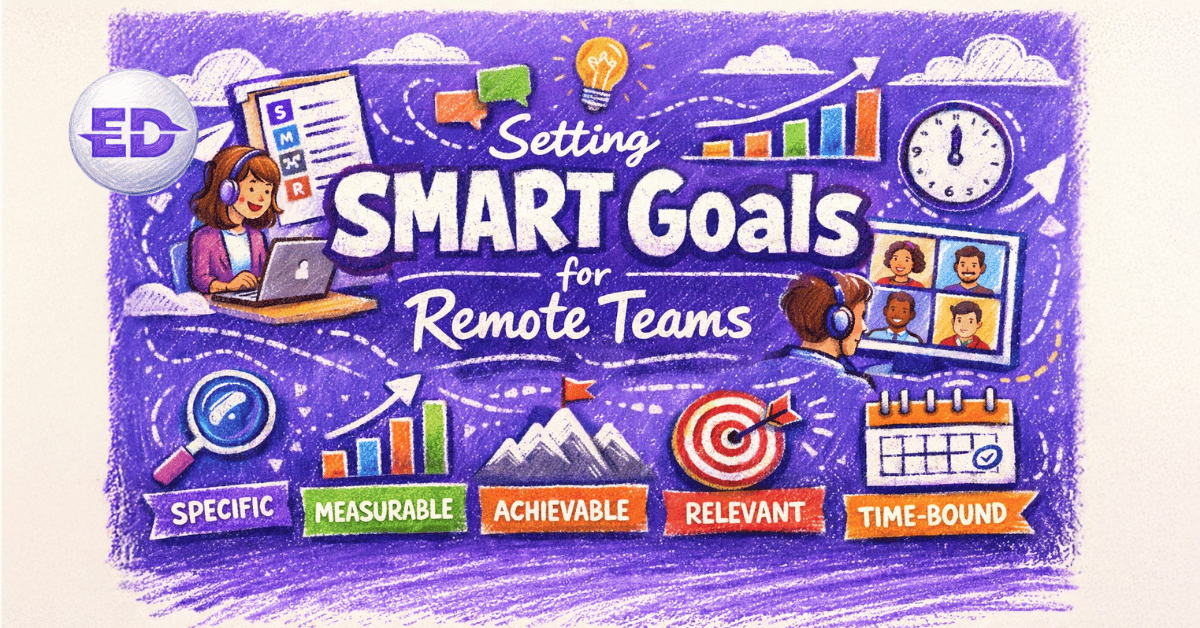
In 2026, the best remote teams (GitLab, Doist, Automattic) don’t just use SMART goals. They use SMART 2.0.
Experience the SMART 2.0 Framework
Here is how defining goals changes when you can’t see your team.
S - Specific (The “Definition of Done”)
- Old Way: “Increase website traffic.”
- Remote Way: “Publish 4 SEO-optimized blog posts per week targeting keywords with >1k volume.”
- Why: In remote work, if the output isn’t explicitly defined, the outcome will be random. You need a “Definition of Done” that is binary (Yes/No).
M - Measurable (The Dashboard Test)
- The Rule: If I can’t see it on a dashboard (Looker, Mixpanel, Linear), it doesn’t exist.
- Remote Twist: Tracking “hours worked” is useless. Track Output Metrics (Revenue, Code Shipments) or Input Metrics (Calls made, Articles written).
A - Asynchronous (Replacing “Achievable”)
- The Shift: Goals should not require synchronous meetings to move forward.
- Example: Instead of “Hold a daily standup to track progress,” set a goal of “Update the Notion tracker by 10 AM EST daily.”
- Why: Sync-dependent goals fail across time zones. Async-first goals survive.
R - Relevant (The “Why” Link)
- Context is King: Remote workers often feel isolated from the “Big Picture.”
- The Fix: Every goal must link to a Company OKR.
- Goal: “Fix 10 bugs.”
- Relevance: “Because our Q1 Focus is ‘Enterprise Reliability’.”
- Result: The engineer picks the critical bugs, not the easy ones.
T - Transparent (Replacing “Time-bound”)
- The Open Book: In an office, you see people working. Remotely, you don’t.
- The Fix: Work must be visible by default.
- Private: DMing the boss an update.
- Transparent: Posting the update in the
#marketing-goalspublic channel. - Benefit: Prevents duplication of work and builds trust without micromanagement.
The “Anti-Goals” (What to Avoid)
- “Do your best” Goals: They result in burnout or laziness. Be exact.
- Activity Goals: “Send 100 emails.” Better: “Book 5 demos.” Focus on valid outcomes.
- Hidden Goals: “I expected you to also do X.” If it wasn’t written down, it wasn’t assigned.
Tools for Remote Goal Tracking
| Tool | Best For | Why Remote Teams Love It |
|---|---|---|
| Linear | Engineering | Links code (PRs) directly to goals (Issues). |
| Lattice | HR / People | Connects individual goals to company-wide OKRs. |
| Notion | Documentation | The “Source of Truth” for quarterly planning. |
Conclusion
Remote work forces you to be a better manager. You can’t rely on charisma or presence. You must rely on clarity.
If your team is missing deadlines, don’t blame “remote work.” Blame the ambiguity of the goal. Tighten the definition, make the dashboard visible, and watch the output soar.
FAQ
How often should we review goals remotely? More often than in-person. A weekly “Async Check-in” (written update) is standard. A monthly “Sync Review” (Zoom call) helps clear blockers.
What if a goal becomes irrelevant mid-quarter? Kill it immediately. In remote teams, “Zombie Goals” (goals nobody cares about but everyone is still working on) are common because communication is slower. Be ruthless about deprioritizing.
How do I set goals for creative work (Design/Writing)? Focus on Quantity + Standard.
- Bad: “Design a good logo.”
- Good: “Produce 3 logo variations based on the Brand Kit by Friday. 1 must be minimal, 1 abstract.”
Should we track “Hours Worked”? No. It encourages “Mouse Moving” behavior. Track outcomes. If someone hits their sales quota in 20 hours, give them a medal, not more work.
How do I handle time zones with deadlines? Always specify the time zone. “Due Friday” is dangerous. “Due Friday at 5 PM EST” is clear. Better yet: “Due Friday End of Your Day.”
What is the “Manager’s User Manual”? It’s a document where you write down how you assess goals. “I value speed over perfection” or “I value detailed documentation.” Share this with your remote team so they know how to win.