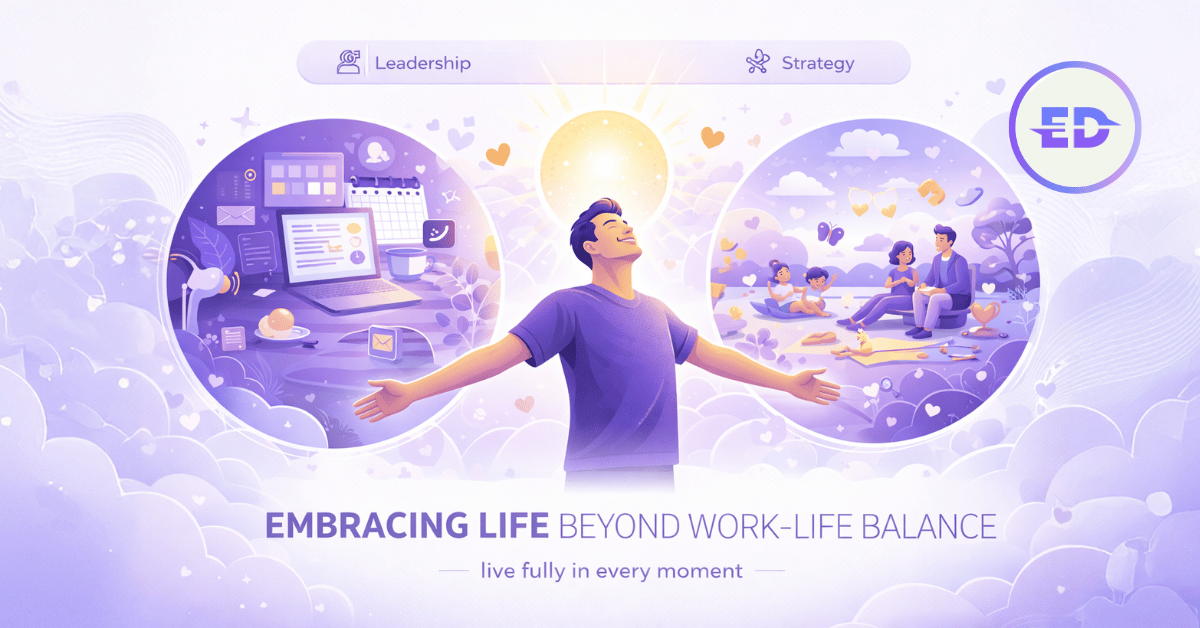
The phrase “Work-Life Balance” implies a trade-off. It suggests a zero-sum game where Work and Life are opposing forces on a see-saw. If work goes up, life must go down.
This model is broken. In 2026, where remote work is the default and the 9-to-5 is dead, attempting to “balance” these two is a recipe for burnout.
The new paradigm isn’t Balance. It’s Integration.
Why “Balance” is a Trap
Balance assumes separation. It assumes you have a “Work Self” who wears a suit (or a Zoom shirt) and a “Life Self” who has hobbies. But you are one person.
When you try to balance, you create friction. You feel guilty checking an email at 8 PM, and you feel guilty taking a walk at 2 PM. You are constantly policing your own boundaries, consuming mental energy that could be used for creation.
The 4 Pillars of Work-Life Integration
Successful founders and operators don’t balance; they blend. Here is the framework for sustainable high performance.
1. Manage Energy, Not Time
Time is finite; energy is renewable.
- The Trap (Balance): “I must work 8 hours a day.”
- The Solution (Integration): “I will work when I have high energy.” If you are a night owl, code at 1 AM. If you hit a slump at 2 PM, go to the gym. Don’t fight your circadian rhythm; leverage it.
2. Seasons of Life
You cannot be balanced every day. But you can be balanced over a year.
- The Sprint Season: When launching a product, you might work 14 hours a day for 3 weeks. That’s okay.
- The Recovery Season: After the launch, take 2 weeks off.
- The Maintenance Season: The standard 30-40 hour week. Be honest about which season you are in. Burnout happens when you try to Sprint for 365 days.
3. Asynchronous by Default
In 2026, “Presenteeism” is a sin.
- Synchronous: Meetings, instant replies. Drains energy.
- Asynchronous: Deep work, Loom videos, written docs. Restores focus. Design your life so that work happens on your timeline, not the timeline of the most anxious person in your Slack channel.
4. Integration, Not Contamination
Integration means bringing your whole self to work. Contamination means letting work poison your rest.
- Integration: bringing your passion for design into a slide deck.
- Contamination: Checking Slack during dinner with your family. The Rule: Be 100% present where your feet are. If you are working, work clearly. If you are resting, rest deeply.
Tools for Integration
| Tool | Purpose | How to Use |
|---|---|---|
| Oura Ring / Whoop | Energy Metric | Check your Readiness Score. Low score? Cancel meetings. High score? Do deep work. |
| Rise Calendar | Circadian Sync | Auto-blocks your calendar during your “Energy Dips” for low-focus tasks. |
| Freedom / Opal | Digital Walls | Hard-blocks work apps (Slack/Email) during “Life Seasons” (e.g., weekends). |
Conclusion
Stop trying to cut your life into two equal halves. You are not a pizza.
You are a complex system. Work gives you purpose; Life gives you fuel. They feed each other. The goal is not to escape work to find life, but to build a life where work is a meaningful, integrated part of the whole.
Don’t seek balance. Seek harmony.
FAQ
What is the difference between Work-Life Balance and Integration? Balance is about boundaries (keeping them separate). Integration is about synergy (making them work together). Balance says “No work after 5 PM.” Integration says “I’ll go to the gym at 2 PM and finish this report at 8 PM because that suits my energy better.”
Can you have integration with a strict boss? It’s harder, but possible. Focus on output, not hours. If you deliver 10x results, most bosses won’t care when you did the work. If they do, you’re in the wrong company for 2026.
Does integration mean working all the time? No. It means working flexibly. It actually requires stricter “Deep Rest” protocols because there is no external clock telling you to stop. You must self-regulate.
How do I prevent burnout with this model? By respecting the “Seasons.” If you are in a Sprint Season, you must plan a Recovery Season immediately after. You cannot integrate a marathon sprint forever.
Is this only for remote workers? It’s easiest for remote workers, but hybrid workers can use it too. Use your office days for collaboration (Synchronous) and your home days for deep work (Asynchronous).
What is the “Sunday Scaries” and how does this fix it? The Sunday Scaries happen when you dread the transition from “Life Self” to “Work Self.” With integration, there is less friction because the two selves are closer together. You don’t “go” to work; you simply shift focus.