Introduction: Events as a Growth Engine
In a digital-first world saturated with content and virtual noise, live events have become the most powerful differentiation tool available to startups. Events create the high-trust, high-context interactions that digital channels cannot replicate.
Event-led growth (ELG) uses events — meetups, workshops, conferences, and community gatherings — as a primary driver of customer acquisition, retention, and revenue. It is not about hosting occasional networking drinks. It is about building a systematic events programme that compounds brand equity and generates measurable business outcomes.
In India’s startup ecosystem in 2026, ELG is particularly potent. The cultural preference for face-to-face interaction, the density of startup talent in Bangalore, Mumbai, and Delhi, and professionals’ willingness to invest time in learning events create ideal conditions.
Why Events Work: The Trust Acceleration Effect
A potential customer who attends your workshop, hears your expertise firsthand, and interacts with your team builds more trust in 2 hours than through 6 months of content consumption.
Event-sourced leads convert at 2-3x the rate of inbound leads. Customers acquired through events have 40% higher lifetime value. Brand recall after in-person interaction is 5-8x higher than digital-only interaction.
Events also create content flywheels. A single 2-hour workshop generates material for 20-30 social media posts, 3-4 blog articles, a podcast episode, and a highlight reel — extending impact far beyond the room.
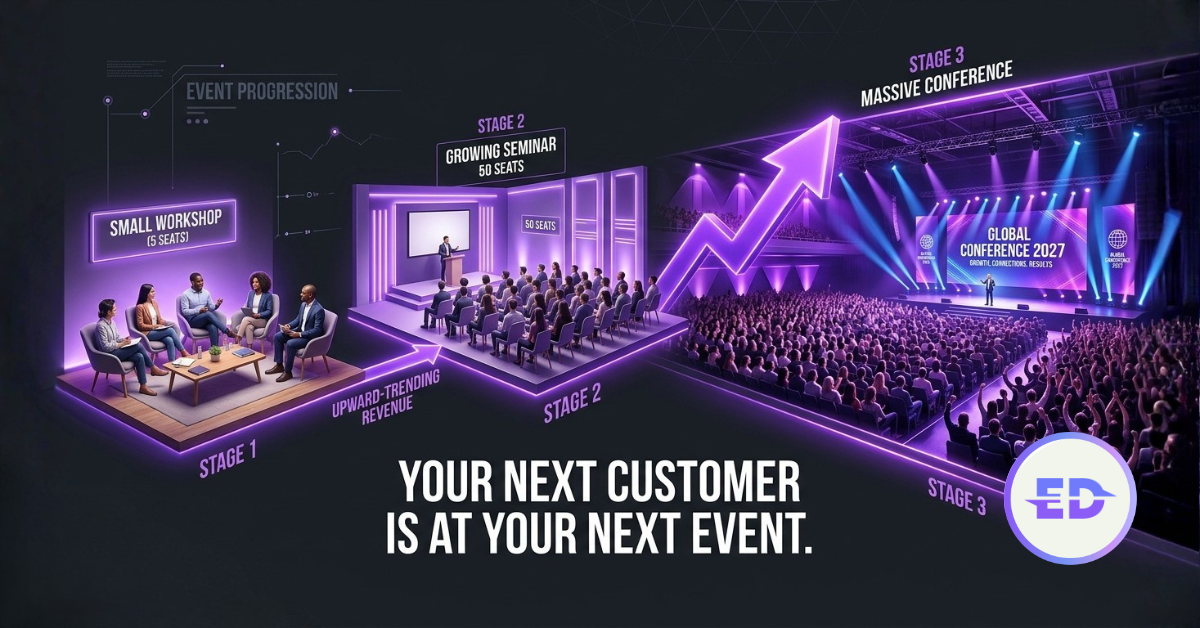
The Events Ladder: From Casual to Revenue-Generating
Rung 1: Casual Meetups (Free, 15-30 People)
Informal gatherings around a theme — “SaaS Founders Coffee” or “D2C Operators Roundtable.” Minimal structure, maximum networking.
Purpose: Build initial community and identify active participants. Cost: Rs 5,000-15,000 (venue, refreshments). Revenue: None directly — these are relationship investments. Frequency: Monthly.
Rung 2: Workshops (Free or Rs 500-1,500, 30-80 People)
Structured learning sessions teaching a specific skill. “Setting Up Unit Economics for Your D2C Brand” or “Building Your First SaaS Sales Playbook.”
Purpose: Demonstrate expertise and generate leads. Cost: Rs 15,000-40,000 (venue, equipment, refreshments, speaker). Revenue: Ticketed at Rs 1,000 x 50 attendees = Rs 50,000; net Rs 10,000-35,000. Frequency: Bi-monthly.
Rung 3: Conference-Style Events (Rs 2,000-10,000, 100-500 People)
Multi-session events with multiple speakers, panels, networking, and sponsor presence.
Purpose: Brand positioning as industry leader, significant lead generation, sponsorship revenue. Cost: Rs 2-8 lakh. Revenue: Tickets (Rs 3,000 x 200 = Rs 6 lakh) plus sponsorships (3 x Rs 1-2 lakh = Rs 3-6 lakh). Total: Rs 9-12 lakh. Frequency: Quarterly.
Rung 4: Flagship Annual Event (Rs 5,000-25,000, 500-2,000 People)
Your signature event that the industry anticipates. Establishes your brand as the centre of gravity for your niche.
Purpose: Industry leadership, premium sponsorship, major lead generation, media coverage. Cost: Rs 10-50 lakh. Revenue: Rs 20 lakh-1 crore from tickets plus premium sponsorship packages. Frequency: Annual.
The Operational Playbook
Pre-Event (6-8 Weeks Before)
Create a compelling event page that sells outcomes, not agendas. “You will leave with a complete unit economics model” beats “Join us for a workshop on unit economics.”
Invite speakers who bring their own audience — a speaker with 10,000 LinkedIn followers who promotes effectively is worth more than a brilliant unknown.
Promotion channels: community and email list first, then LinkedIn (most effective for Indian professional events), Instagram for consumer-facing events, and partnership promotions with complementary communities.
Use Luma, Lu.ma, or Townscript for registration. Collect qualifying information — company name, role, and one question about their biggest challenge.
During the Event
Record everything. Hire a photographer. Assign a note-taker for quotable moments. This content fuels marketing for weeks.
Facilitate networking with structure — speed networking (3-minute rotations), discussion tables by topic, or facilitated introductions based on shared interests.
Capture feedback during the event with a simple one-question survey — 5x the response rate of post-event email surveys.
Post-Event (1-2 Weeks After)
Thank-you email within 24 hours with key takeaways, photos, and recordings. Personalised outreach to high-potential leads within 48 hours.
Turn content into 2-3 blog posts, 10-15 social media posts, a highlight video, and a podcast episode. Each piece links to the next event.
Move qualified leads into the sales pipeline — attendees who expressed specific pain points are warm leads.
Building the Sponsorship Revenue Engine
Creating Valuable Sponsorship Packages
Effective elements: speaking slot where sponsor presents a case study (not a sales pitch), workshop hosting using their tool, facilitated introductions between sponsor and relevant attendees, and content co-creation for post-event distribution.
Pricing Framework
Base visibility: Rs 50,000-1,00,000 for 100-200 attendee events. Premium packages with speaking: 2-3x base. Title sponsorship: 5-10x base.
Ticket Pricing Psychology (Indian Market)
Free events: high volume, 40-50% show rate, low commitment. Rs 200-500: moderate commitment, 60-70% show rate. Rs 1,000-3,000: serious professionals, 75-85% show rate. Above Rs 5,000: senior professionals and decision-makers, 85-95% show rate.
Higher-priced events often generate better outcomes for everyone — more revenue, better sponsors, more committed peers, better networking.
The Revenue Compounding Cycle
Early events (free or low-cost) build community and credibility. Credibility attracts paying sponsors. Sponsors subsidise better events. Better events attract more attendees. More attendees attract premium sponsors. Premium sponsors enable flagship events. Flagship events establish industry leadership.
This cycle takes 12-18 months to reach maturity. Treat the first 3-4 events as investments that build the foundation.
Measuring Event-Led Growth
Attendee Growth: 20-30% growth per event in year one.
Lead Quality: 10-15% of attendees become qualified leads; 20-30% of those convert to customers.
Sponsorship Revenue Growth: 30-50% year-over-year.
Content Amplification: 10-20x content impressions compared to attendee count.
Community Growth: Each event should drive 5-15% community membership growth.
FAQ
How much does it cost to host a startup meetup in India? A casual meetup for 15-30 people costs Rs 5,000-15,000 covering venue and refreshments. A structured workshop for 30-80 people costs Rs 15,000-40,000. A conference-style event for 100-500 people costs Rs 2-8 lakh. Many coffee shops, co-working spaces, and startup hubs in Bangalore, Mumbai, and Delhi offer free or low-cost event space for startup communities.
What is the ROI of event-led growth compared to digital marketing? Event-sourced leads convert at 2-3x the rate of inbound leads, and customers acquired through events have 40% higher lifetime value. A single 2-hour workshop generates material for 20-30 social posts, 3-4 blog articles, and a podcast episode. Brand recall after in-person interaction is 5-8x higher than digital-only interaction. The upfront cost is higher, but the compounding returns over 12-18 months make events one of the highest-ROI growth investments.
How do I get sponsors for my startup events? Start by hosting 3-4 successful free events to build credibility and demonstrate audience engagement. Then approach companies whose products serve your audience with specific sponsorship packages. The most attractive packages include speaking slots, facilitated introductions with attendees, and content co-creation opportunities. For a 100-200 person event in India, base sponsorship starts at Rs 50,000-1,00,000.
What is the right ticket price for events in the Indian market? Free events get high volume but only 40-50% show up. Rs 200-500 gets moderate commitment with 60-70% attendance. Rs 1,000-3,000 attracts serious professionals with 75-85% attendance. Above Rs 5,000 targets senior decision-makers with 85-95% attendance. Higher-priced events often generate better outcomes for everyone — more revenue, better sponsors, more committed peers, and better networking.
How many events should a startup host per month? Start with one monthly casual meetup to build community and relationships. After 3-4 months, add bi-monthly workshops. After 6 months with proven demand, add quarterly conference-style events. By month 12, aim for one annual flagship event. Most startups overestimate the frequency they can sustain and underestimate the preparation each event requires. Quality always beats quantity in event-led growth.
Key Takeaway
“Events are not a marketing expense — they are a revenue engine. The startup that hosts the best events in its niche owns the relationship with its market. In India, where trust is built through personal interaction, events are the highest-ROI growth investment available.” — Evan D’Souza, Growth Architect
Part of the Community-Led Growth series on evandsouza.com.