Every successful business decision starts with clarity. Before you launch a product, enter a new market, raise funding, or pivot your strategy — you need to understand where you stand and what you’re up against.
That’s exactly what the SWOT Analysis delivers. It’s one of the most enduring strategic frameworks in business, used by everyone from Fortune 500 executives to solo founders building from their living rooms.
In this guide, we’ll break down SWOT Analysis with the depth it deserves — not just the theory, but practical applications, real examples, and tools that make it actionable in 2026.
What Is SWOT Analysis?
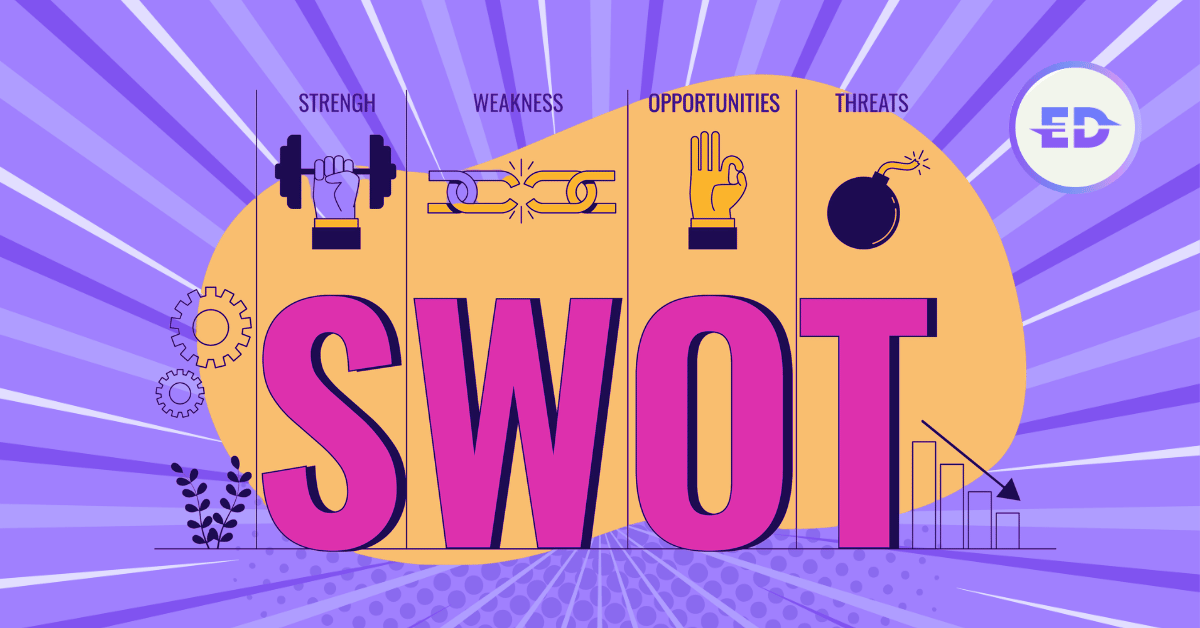
SWOT stands for Strengths, Weaknesses, Opportunities, and Threats. It’s a strategic planning framework that helps you evaluate both internal capabilities and external factors affecting your business.
The beauty of SWOT is its simplicity. Four quadrants. One powerful picture of your competitive position.
The Four Quadrants Deep Dive
Strengths — What You Do Better Than Anyone
Strengths are internal, positive factors — the advantages, assets, and capabilities that set your business apart.
Questions to ask yourself:
- What do our customers consistently praise us for?
- What resources do we have that competitors don’t?
- What’s our unfair advantage — team, technology, brand, data?
- Which processes work exceptionally well?
Examples for a SaaS startup:
- Proprietary AI algorithms with 95% accuracy
- A founding team with deep domain expertise
- Strong organic traffic and SEO authority
- Low customer acquisition cost compared to competitors
Weaknesses — Where You Fall Short
Weaknesses are internal, negative factors — the gaps, limitations, and vulnerabilities holding you back.
Questions to ask yourself:
- Where do customers complain the most?
- What do competitors do better than us?
- Where are we under-resourced — team, capital, technology?
- What processes are inefficient or manual?
Examples for a SaaS startup:
- Limited brand recognition in a crowded market
- High churn rate on the free-to-paid conversion
- Dependency on a single acquisition channel
- Slow customer support response times
Opportunities — Doors Waiting to Be Opened
Opportunities are external, positive factors — trends, market shifts, and unmet needs you can capitalize on.
Questions to ask yourself:
- What industry trends align with what we’re building?
- Are there underserved customer segments we can reach?
- What partnerships or integrations could accelerate growth?
- What regulatory or market changes create openings?
Examples for a SaaS startup:
- Growing demand for AI-powered automation tools
- Potential partnerships with enterprise platforms
- Expansion into international markets with localization
- Competitor acquisitions leaving gaps in the market
Threats — Obstacles That Demand Attention
Threats are external, negative factors — risks, competition, and forces that could harm your business.
Questions to ask yourself:
- Who are our biggest competitors, and what are they doing?
- What economic or regulatory changes could impact us?
- Are there technology shifts that could make us obsolete?
- What customer behavior trends could reduce demand?
Examples for a SaaS startup:
- Established tech giants entering your niche
- Rising cybersecurity risks and compliance costs
- Economic downturn reducing enterprise budgets
- Open-source alternatives gaining traction
Real-World SWOT Example: D2C E-Commerce Platform
Here’s a practical SWOT for a hypothetical D2C e-commerce platform in 2026:
| Positive | Negative | |
|---|---|---|
| Internal | Strengths: AI-powered personalized recommendations, loyal customer base (40% repeat rate), agile development team shipping weekly | Weaknesses: Limited brand awareness outside core market, dependency on third-party logistics, small marketing budget |
| External | Opportunities: India’s D2C market projected to hit $100B by 2027, growing social commerce trend, untapped Tier 2/3 city demand | Threats: Intense competition from marketplace giants, rising customer acquisition costs, rapid changes in consumer preferences |
How to Conduct a SWOT Analysis: Step by Step
Step 1: Assemble the Right People
Don’t do SWOT alone. Include founders, department heads, and even customer-facing team members. Diverse perspectives surface blind spots.
Step 2: Gather Data First
Before brainstorming, arm your team with:
- Customer feedback and NPS scores
- Competitive analysis reports
- Market trend data and industry reports
- Financial metrics and unit economics
- Team capability assessments
Step 3: Brainstorm Each Quadrant
Spend 15–20 minutes per quadrant. Use sticky notes (physical or digital via Miro/FigJam) to capture ideas without filtering. Quantity first, quality later.
Step 4: Prioritize and Rank
Not all items are equal. Rank each factor by impact (high/medium/low) and likelihood. Focus on the top 3–5 items per quadrant.
Step 5: Build Action Plans
This is where most teams fail — they do the analysis but don’t act. Convert your SWOT into actions:
| Quadrant | Action Framework |
|---|---|
| Strengths | How can we double down and differentiate further? |
| Weaknesses | What’s the plan to fix or mitigate the top 3? |
| Opportunities | Which 1–2 can we pursue this quarter? |
| Threats | What contingency plans do we need? |
Step 6: Review Quarterly
Markets shift, competitors evolve, and your own capabilities change. Revisit your SWOT every quarter to keep it relevant.
Best Tools for SWOT Analysis in 2026
| Tool | Best For | Why |
|---|---|---|
| Miro / FigJam | Collaborative workshops | Real-time brainstorming with templates, voting, and sticky notes |
| Notion | Living documents | Create a SWOT database that evolves with your business |
| Canva | Visual presentations | Beautiful SWOT diagrams for investor decks and team alignment |
| Google Sheets | Quick and free | Simple 2×2 grid with color-coding and conditional formatting |
| Lucidchart | Professional diagrams | Polished SWOT charts for stakeholder presentations |
| ChatGPT / Claude | AI-assisted analysis | Feed in your data and get a first-draft SWOT to refine with your team |
Pro tip for 2026: Use AI tools to generate a preliminary SWOT from your existing data (analytics, customer reviews, competitor websites), then refine it collaboratively with your team. This saves hours of manual research.
Common SWOT Mistakes to Avoid
- Being vague — “Good team” isn’t a strength. “3 engineers with 10+ years in ML” is.
- Confusing internal and external — Strengths/Weaknesses are about you. Opportunities/Threats are about the market.
- Listing without ranking — 20 items per quadrant is noise. Prioritize the top 3–5.
- Doing it once and forgetting — SWOT is a living framework. Review quarterly.
- Not converting to action — Analysis without execution is just a document gathering dust.
Key Takeaways
SWOT Analysis isn’t just for MBA textbooks — it’s a practical, powerful framework that every founder and operator should use regularly. The best strategic decisions come from understanding your position clearly and acting on that understanding decisively.
The formula:
Know your strengths → Acknowledge your weaknesses → Seize opportunities → Prepare for threats → Act.
Start your SWOT today. Grab your team, block 90 minutes, and run through the steps above. The clarity you’ll gain is worth every minute.
FAQ
What does SWOT stand for? SWOT stands for Strengths, Weaknesses, Opportunities, and Threats. It’s a strategic planning framework that evaluates internal capabilities (strengths and weaknesses) and external factors (opportunities and threats) to guide business decisions.
When should a startup conduct a SWOT Analysis? Ideally quarterly, and always before major decisions — launching a new product, entering a new market, raising funding, or pivoting strategy. Early-stage startups should do their first SWOT before creating their pitch deck.
How is SWOT different from PESTLE Analysis? SWOT covers both internal and external factors across all dimensions. PESTLE (Political, Economic, Social, Technological, Legal, Environmental) focuses exclusively on external macro-environment factors. Many strategists use PESTLE to feed into the Opportunities and Threats quadrants of their SWOT.
Can I use AI tools to do a SWOT Analysis? Yes, and in 2026 it’s highly recommended as a starting point. Feed your business data, customer reviews, and competitor information into AI tools like ChatGPT or Claude to generate a draft SWOT, then refine it with your team’s domain expertise and judgment.
What’s the biggest mistake people make with SWOT? Treating it as a one-time exercise and filing it away. The real value comes from converting SWOT insights into specific action items, assigning owners, setting deadlines, and reviewing progress quarterly.
How many items should each SWOT quadrant have? Focus on the top 3–5 items per quadrant, ranked by impact and likelihood. Having 20 items per quadrant creates noise and makes it harder to prioritize. Quality and specificity matter more than quantity.