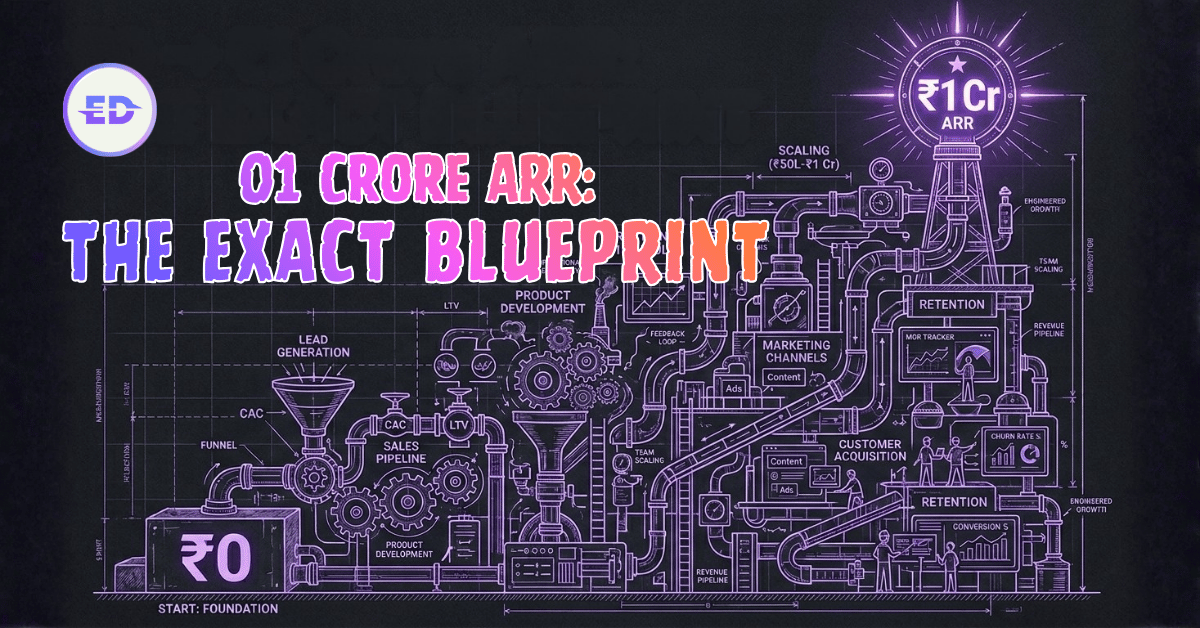
Rs 1 crore ARR is a useful milestone because it forces a startup to do more than close a few enthusiastic customers. It requires a repeatable connection between demand, conversion, delivery, retention and economics.
The mistake is treating the journey as a universal sequence of hires and channel benchmarks. A founder selling a high-touch compliance product and a founder selling a self-serve productivity tool can reach the same revenue with completely different operating systems.
This framework uses stage gates instead. A stage gate is evidence the business must produce before adding the next layer of cost or complexity.
The Growth Architecture in One View
| Gate | Question | Evidence |
|---|---|---|
| Problem | Is the problem expensive and specific? | Repeated customer language and an existing workaround |
| Value | Do customers reach a meaningful outcome? | A defined first value event and observed completion |
| Revenue | Can the founder repeat the sale? | Consistent buyer, trigger, objection and close logic |
| Delivery | Can the team fulfil the promise reliably? | Owned handoffs, stable onboarding and visible exceptions |
| Retention | Does value continue after the first win? | Cohort retention, expansion and product usage evidence |
| Economics | Does growth produce healthy contribution? | Gross margin, acquisition cost, payback and cash visibility |
Do not graduate because a calendar says it is time. Graduate when the evidence is strong enough that the next investment has a clear job.
Gate 1: Problem Evidence
Before building a growth engine, verify that the problem is not merely interesting. It should recur, carry a cost and already cause the customer to spend time, money or political capital on a workaround.
Interview recent prospects, customers who bought, customers who did not buy and users who stopped engaging. Capture their exact language. Then run the signal through a voice-of-customer operating loop so feedback becomes a ranked decision input rather than a folder of quotations.
Useful evidence includes:
- the same job appearing across several accounts;
- a visible trigger that makes the problem urgent;
- a current workaround with a named owner;
- a consequence if the customer does nothing;
- a buyer who can fund the change.
Weak evidence includes compliments, wait-list signups with no commitment and broad statements such as “we need better automation.”
Gate 2: First Value
Growth magnifies whatever onboarding already does. If new customers wait, repeat information or require founder rescue, more demand creates more operating debt.
Define one first value event. It should describe a customer outcome, not an account action. “Created a workspace” is setup. “Completed the first weekly operating review using live data” is value.
Map the path from signed agreement or signup to that event:
- What does the customer need to provide?
- Which step depends on your team?
- Where can work wait without an owner?
- Which configuration can be postponed?
- What evidence confirms the customer received value?
Use the time-to-value framework for B2B SaaS onboarding to remove waits before adding onboarding staff or more software.
Gate 3: Repeatable Revenue
Early sales should remain close to the founder until the company understands why customers buy. The objective is not founder heroics forever. It is to produce enough decision evidence that another person can operate the process without pretending every account is unique.
After each meaningful opportunity, record:
- customer trigger;
- desired outcome;
- stakeholders and approval path;
- alternatives considered;
- objection that changed the decision;
- reason won or lost;
- promised first value event.
When the pattern stabilises, document a sales path with explicit exit criteria. A stage should describe evidence, not activity. “Demo completed” says what the seller did. “Buyer confirmed the problem, decision process and next commitment” says what is now true.
Choose product-led, sales-led or hybrid growth based on product complexity, buyer risk and service cost. Do not choose a model because it is fashionable.
Gate 4: Repeatable Demand
The first demand system should follow the strongest evidence from closed and lost customers. If buyers search for a defined problem, build a search and editorial system. If the category requires trust and education, founder-led content, workshops or communities may work better. If the buying trigger is narrow and observable, focused outbound may be appropriate.
Every channel needs four definitions:
- Audience: Who is the buyer in this channel?
- Trigger: Why would they pay attention now?
- Promise: Which useful outcome does the message offer?
- Conversion: What meaningful next step can be measured?
For organic discovery, the AI search SEO guide for startups covers crawlability, source quality, entity clarity and distribution. The job is not to publish at volume. It is to become the strongest available answer to a problem your buyers already recognise.
Do not diversify because one channel feels boring. Add a second channel when the first has a documented process, visible economics and a clear constraint that another channel can solve.
Gate 5: Delivery Without Founder Rescue
Revenue is not repeatable if every new account creates a private exception queue for the founder.
If you need to locate that concentration before changing roles or adding headcount, run the private Founder Dependency Scorecard. It separates decision, context, customer continuity and operating visibility signals without collecting individual answers.
Trace one customer across sales, onboarding, product and success. At each handoff, define:
- what information must travel;
- which system contains the current truth;
- who owns the next action;
- when the handoff is complete;
- how an exception is escalated.
Measure elapsed time, reopen rate and manual rescue. A handoff can look complete in a CRM while the customer is still waiting for the real work to begin.
Hire after the workflow is visible. A new person should inherit a clear outcome and decision boundary, not become the human integration between scattered tools.
Gate 6: Retention and Expansion
Acquisition can hide a weak customer system for a while. Cohort retention exposes it.
Stripe’s current SaaS metrics guide groups acquisition, engagement, retention, growth and economic metrics rather than treating ARR as a complete view of health. Use that same balance.
At minimum, review:
- logo and revenue retention by cohort;
- time to first value;
- adoption of the behaviour associated with ongoing value;
- expansion, contraction and churn reasons;
- support and success effort per account.
Net revenue retention measures how recurring revenue from an existing cohort changes after expansion, contraction and churn. Stripe’s NRR guidance notes that results above 100% indicate expansion outweighing lost recurring revenue, but the benchmark varies by business model and stage. Compare against your own cohorts before borrowing a generic target.
An expansion is healthy when it follows additional customer value. It is not healthy when it comes from confusing packaging or surprise usage charges.
Gate 7: Economics That Survive Growth
ARR alone cannot tell you whether the system creates a good business. Track the cost of delivering and supporting the revenue.
Use a small operating set:
- recurring revenue movement;
- gross margin by product or customer segment;
- acquisition cost and payback by channel;
- retention and expansion by cohort;
- support and implementation cost;
- burn and cash runway.
If the product uses model APIs, compute AI cost per completed customer outcome, not only cost per token. The AI SaaS pricing and gross-margin guide shows how to connect usage, contribution margin and packaging.
Pricing should reflect value and cost-to-serve without pretending every Indian buyer behaves the same way. Use the SaaS pricing framework for Indian startups as a research process, then test willingness to pay with real segments.
The Weekly Growth Review
Run one operating review that joins the whole system:
- Which customer outcomes improved or regressed?
- Where did work wait or require rescue?
- Which demand source created qualified movement?
- What changed in conversion, time to value and retention?
- Which assumption needs evidence next?
- What is the single constraint to remove this week?
Keep the review decision-led. A dashboard with twenty metrics and no owner is reporting theatre.
When to Hire
Hire when a repeatable constraint has a stable outcome that a person can own.
- Hire sales when the founder can teach a repeatable decision process.
- Hire customer success when the value path is known and the account load prevents proactive work.
- Hire growth when a channel has evidence and needs deeper execution.
- Hire operations when cross-functional waits are visible and recurring.
Do not hire merely because the founder is busy. Founder busyness can come from unclear decisions, unnecessary approvals or a broken handoff. Diagnose the work before adding capacity.
FAQ
How long should it take to reach Rs 1 crore ARR?
There is no responsible universal timeline. Price point, sales cycle, market maturity, implementation effort and retention all change the path. Set stage gates around evidence and cash rather than copying another company’s calendar.
Should an Indian SaaS startup begin with product-led or sales-led growth?
Choose based on buyer risk, product complexity, time to value and contract economics. Low-friction products may support self-serve adoption. Complex or consequential products usually require human guidance. Many businesses use a hybrid motion, but it should be earned by customer behaviour.
When should the founder hire the first salesperson?
Hire after the founder can describe the ideal customer, trigger, discovery logic, objections, decision process and reasons won or lost. Otherwise the salesperson inherits a research problem disguised as a quota.
Which metric matters most before Rs 1 crore ARR?
Use the metric tied to the current constraint. Early on that may be first value completion. Later it may be qualified conversion, retention, gross margin or payback. No single metric governs every stage.
What is the biggest scaling risk?
Adding demand before delivery is repeatable. It increases exceptions, founder rescue and customer inconsistency. Build the customer path and operating handoffs alongside the revenue engine.
Key Takeaway
The path to Rs 1 crore ARR is not a sequence of fashionable hires. It is a chain of evidence: a costly problem, a repeatable first value event, a teachable sale, discoverable demand, reliable delivery, retained value and economics that survive the next customer.